
Work with existing tools
Start with the models and exchange formats a team already uses. The first connection is ArchiCAD to LIRA-SAPR, through SAF and IFC.
NodeSnap builds tools for architects and structural engineers. We start with a familiar gap: an architectural model is ready, but the structural team still has to rebuild it in another tool.
Book a demoA building model carries the work of many design decisions. Columns have locations, beams have sections, and walls have geometry. When that information has to be recreated for analysis, the handoff becomes a separate modelling task.
A revision makes the disconnect more visible. Moving a wall or changing a section can trigger another round of manual edits, with engineers checking whether both versions still describe the same structure.
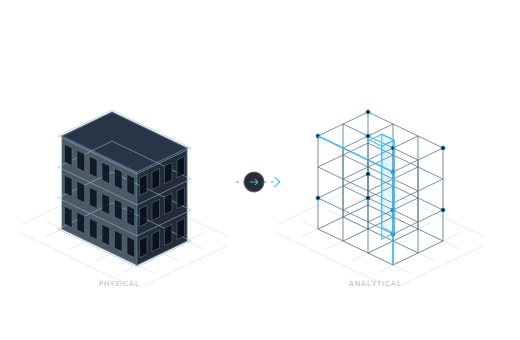
NodeSnap’s core workflow reads ArchiCAD SAF or IFC exports, prepares a LIRA-SAPR analytical model, and checks the result against its source. Conversion, revision sync, and element verification are connected parts of that workflow.
Start with the models and exchange formats a team already uses. The first connection is ArchiCAD to LIRA-SAPR, through SAF and IFC.
A converted model needs a clear relationship to the architectural information behind it. Element-level comparisons make that relationship easier to review.
Automation prepares and checks the model. Engineers remain responsible for the assumptions, analysis, and final design decisions.
NodeSnap is built first for engineers working across Eurocode and Georgian seismic norms, with SNiP-compatible documentation also part of the stated design context.
The work begins at the model handoff: geometry, axes, sections, materials, and the effect of revisions. This keeps the product focused on the preparation and review steps that happen before structural analysis.
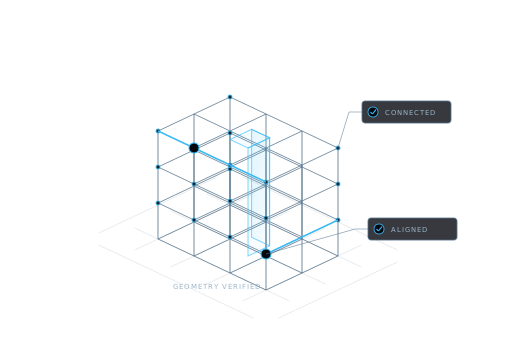
Start with the tools you use and the models you work on.
Book a demo