
Choose a familiar project
Start with an SAF or IFC export from a project your team understands. Select something representative of your normal ArchiCAD-to-LIRA-SAPR work.
Give your engineers a consistent route from architectural exports to analytical models. NodeSnap connects conversion, revision updates, and source verification across the preparation workflow.
Book a demoModel preparation can vary from project to project and engineer to engineer. Each architectural revision creates another point where source information, analytical geometry, and existing assumptions need to be reconciled.
NodeSnap addresses the repeated conversion and update tasks. Your firm can build a clear review process around them: identify the source, inspect the analytical result, resolve exceptions, and confirm who is responsible for the engineering interpretation.
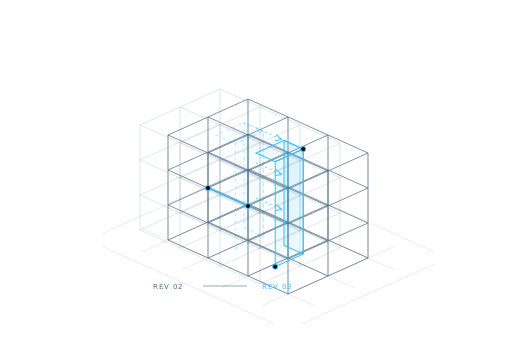
Extract structural information from the architectural export, align members, resolve junctions, and snap nodes. Give the engineer a prepared model to review.
Explore conversionCompare revisions and update changed elements while retaining loads and assumptions. Keep the engineering implications of the change visible in your review process.
Explore revision syncCompare each element with its source, including geometry, axes, sections, and materials. Examine suspicious results before the model advances.
Explore verificationThe person preparing the model and the person responsible for its engineering interpretation may be different. Make that distinction explicit.
| Stage | Team responsibility | Review focus |
|---|---|---|
| Architectural intake | Confirm the source revision and export | Which design the analytical model represents |
| Conversion | Assign an engineer to inspect the result | Connectivity, axes, member properties, and supports |
| Revision update | Reassess the changed design | The continued suitability of retained loads and assumptions |
| Before analysis | Confirm the model’s engineering interpretation | Resolved discrepancies and appropriate analytical assumptions |
A practical evaluation should reveal how the workflow fits your engineers, not simply demonstrate a model on screen.
Start with an SAF or IFC export from a project your team understands. Select something representative of your normal ArchiCAD-to-LIRA-SAPR work.
Bring a before-and-after design change that usually creates rework. Identify which existing loads or assumptions need to carry forward.
Focus on junctions, axes, sections, materials, and supports that need engineering attention. Compare the source and result with the people who know the project.
Decide who prepares the export, who inspects the analytical model, and how unresolved questions return to the design team. Use the evaluation to define the process.
Look at the quality of the analytical representation, how a typical revision is handled, and whether source comparison helps the engineer review difficult elements. Include the people who will prepare and inspect the models.
The workflow described here is ArchiCAD export through SAF or IFC to a LIRA-SAPR analytical model. Raise any other application requirements with the team rather than assuming they are covered.
The responsible engineer still establishes the analytical idealisation, reviews assumptions, and interprets the analysis. NodeSnap supports the preparation and verification work around those decisions.
Bring a representative model, a typical revision, and the people who own the handoff. We’ll discuss how NodeSnap fits your current process.
Request a demo